October 2, 2026
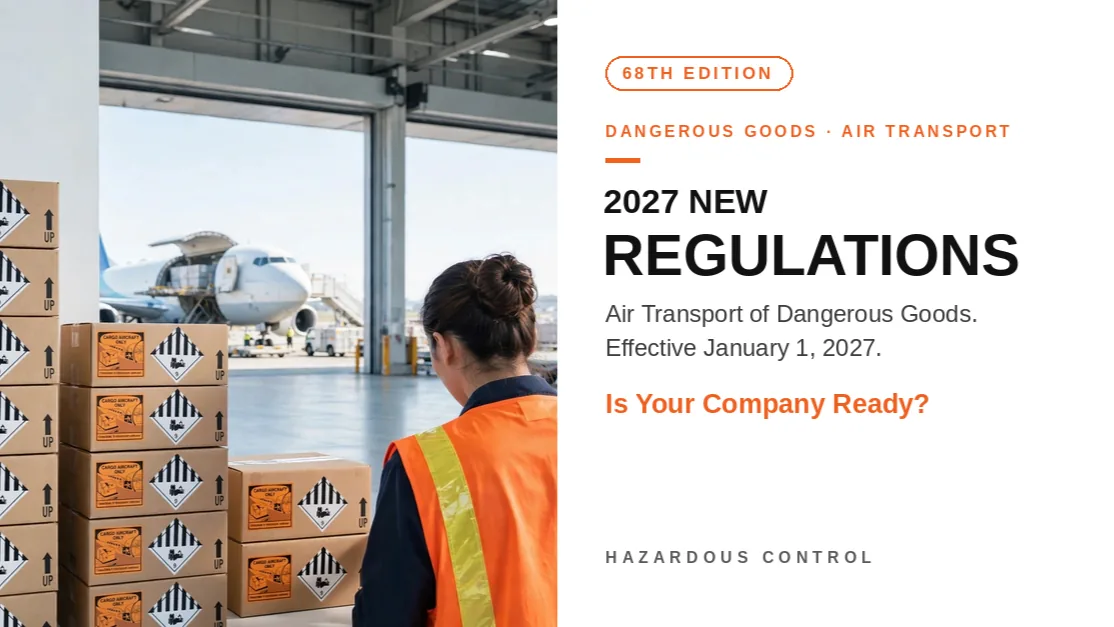
2027 New Regulations: Air Transport of Dangerous Goods. Is Your Company Ready?
By Natalia Perez, Hazardous Control Inc., Miami
On 1 January 2027, the 68th edition of the IATA DGR replaces the book your team is using today. This is not a light update. Batteries are at the center of it, and some of the changes will catch shippers by surprise.
Here is what matters, and what to do about it now.
The date you need on your calendar
The 68th edition takes effect on 1 January 2027. There is no transition year this time: the day the new edition enters into force, your classifications, your packing lines, your documentation and your training records are measured against it. The companies that prepare in the last quarter of 2026 are the ones that will not see shipments rejected in January.
What actually changed
Power banks are now their own category. The DGR no longer treats them as ordinary spare batteries. Passengers and crew are limited to 2 power banks, power banks over 100 Wh are forbidden in the cabin, and the spare battery allowance drops from 20 to 18. And this one will catch passengers by surprise: a power bank must not be recharged on board the aircraft, and it should not be used to charge other devices during the flight.
New UN numbers are coming. UN 3563 and UN 3564 now cover lithium metal and sodium ion batteries installed in a cargo transport unit, and the 68th edition adds classification provisions for hybrid batteries that combine lithium ion and sodium ion cells. If you ship battery-powered equipment, your classifications need a fresh look.
The battery mark moves. It must now appear on the same surface of the package as the other hazard labels. Small detail, easy rejection at acceptance if your packaging line misses it.
Excepted quantities are clarified. Section 2.6 applies to substances, not articles. If your operation relied on the old reading, your procedures need correcting before January.
17 States filed new or amended variations, and the passenger provisions table your staff knows as 2.3.A is being split into three: what needs operator approval, what does not, and what is simply not permitted.
What this means for your operation
Ask yourself two things: Is your team’s training current under the competency-based approach on the 68th edition? And do you know which of the new State and Operator Variations sit on your routes?
Training under the competency-based approach (CBTA) is not a formality. When the edition changes, the competencies your staff was assessed against change with it. Classifications, packing instructions and Shipper’s Declarations built on the 67th edition need a documented review against the 68th, and State and Operator Variations are route-specific: a variation you have never had to think about can become your problem the day a new edition redraws the list.
A rejected shipment in January costs more than training in October.
What to do now
Hazardous Control runs IATA DGR training in English, Spanish and Portuguese, plus classification, documentation and consulting for shippers, forwarders and operators. 20 plus years moving dangerous goods from Miami to the world.
The countdown is real. Start now.
Lack of knowledge does not relieve you of responsibility.
Training
If your team ships or handles batteries or battery-powered equipment by air, function-specific, competency-based DGR training helps turn the 68th edition requirements into practical checks before acceptance: hazardouscontrol.com.
Sources
IATA, Significant Changes and Amendments to the 68th edition of the IATA Dangerous Goods Regulations (2027).
UK Civil Aviation Authority, Changes to rules on the carriage of lithium cells/batteries and power banks (ICAO Technical Instructions addendum, effective 27 March 2026).
By Natalia Pérez, Hazardous Control Inc., Miami. Also published on LinkedIn.