October 15, 2026
Hazmat Emergency Flight: Lithium Battery Involved Again
By Natalia Perez, Hazardous Control Inc., Miami
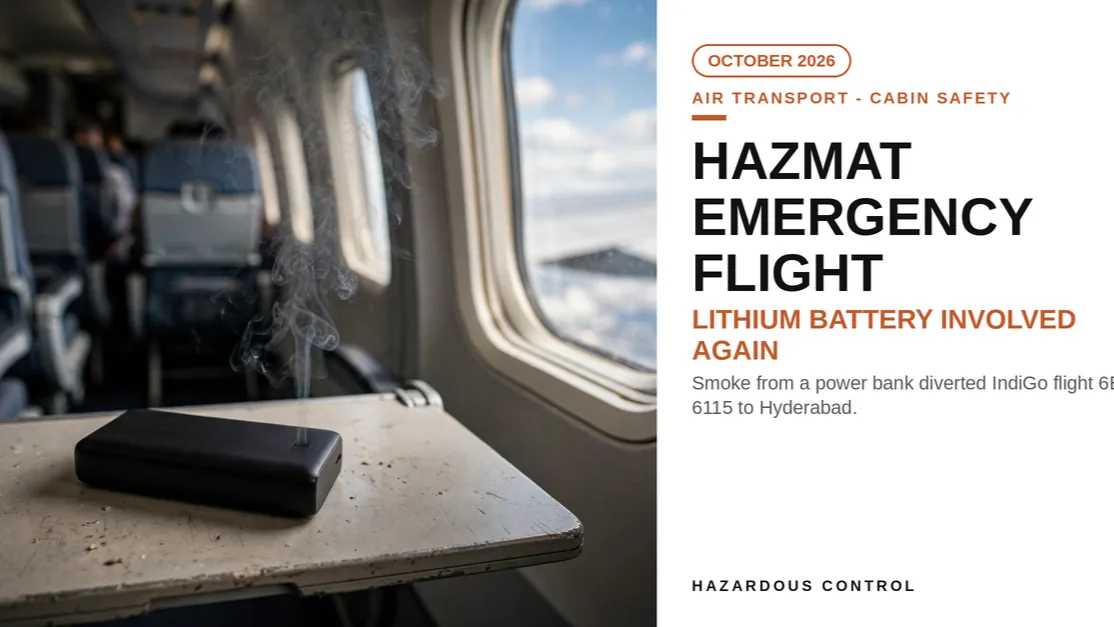
On October 11, 2026, IndiGo flight 6E 6115 was on its way from Delhi to Chennai when smoke started coming from a passenger’s personal electronic device. The crew controlled the situation in the cabin, and the aircraft diverted to Hyderabad, where it landed safely. Passengers continued to Chennai on another aircraft. Early reports point to a power bank as the suspected device. The airline has not confirmed the cause.
One small device, one unscheduled landing, hundreds of disrupted trips. This is the lithium battery problem in a single story, and it keeps repeating.
This is not a rare event anymore
The FAA recorded 97 verified lithium battery events involving smoke, fire or extreme heat aboard aircraft in 2025. That is nearly two a week. ICAO saw this pattern coming: its June 2025 regional safety advisory addressed incidents involving suspected power banks stored in overhead compartments and warned that a battery fire in the cabin can intensify fast and needs a trained response in the first minutes.
A power bank is not a phone. It stores a large amount of energy in a small case, it travels loose in bags and seat pockets, and it often has no brand, no test summary and no way to verify what is inside it. When a cell inside fails, it can enter thermal runaway and ignite the cells next to it.
The rules are already moving
The 68th edition of the IATA DGR, in force on January 1, 2027, treats power banks as their own category for the first time. Passengers and crew are limited to 2 power banks. Power banks over 100 Wh are forbidden in the cabin. A power bank must not be recharged on board, and it should not be used to charge other devices during the flight.
At the United Nations level, the Sub-Committee of Experts on the Transport of Dangerous Goods is expected to consider a hazard-based classification system for lithium and sodium batteries at its session from November 23 to December 1, 2026. That would be a structural change: classify the battery by the hazard it actually presents, not only by its chemistry and size.
And by sea, the World Shipping Council has asked the IMO to close the exemption that lets many lithium batteries travel undeclared in containers, with a declared threshold and placarding above it. Three modes, one direction: batteries are becoming visible cargo, declared and controlled, everywhere.
What this means for your operation
If your company ships batteries, devices or vehicles, the direction of the rules is clear, and acceptance staff are enforcing it today, not in 2027:
- A damaged, swollen or recalled battery does not fly as normal cargo. It follows the damaged and defective provisions, or it does not move.
- State of charge matters. Since January 1, 2026, batteries packed with equipment over 2.7 Wh and lithium ion powered vehicles over 100 Wh must be offered at no more than 30% state of charge for air transport.
- Your people at acceptance are the last filter. The crew of flight 6E 6115 had minutes. Your counter staff have seconds per shipment to spot the battery nobody declared.
Ask yourself three things
When was the last time your acceptance team trained specifically on lithium batteries, not just general dangerous goods?
Could your staff explain, today, what your company does with a swollen power bank a passenger or a customer hands them?
Do your shipping procedures reflect the 30% state of charge rule that has been mandatory since January?
If any answer is no, that is the gap the next incident will find.
Training
Hazardous Control Inc. trains acceptance, warehouse and operations teams on lithium batteries and dangerous goods, online and in person, in English and Spanish. Miami, Doral. hazardouscontrol.com, training@hazardouscontrol.com, (305) 477-1380.
Sources: Travel and Tour World, report on IndiGo flight 6E 6115 diversion, October 2026. ICAO regional safety advisory on lithium battery incidents in the passenger cabin, June 2025. FAA lithium battery incident data, 2025. IATA DGR 68th edition, effective January 1, 2027.
By Natalia Pérez, Hazardous Control Inc., Miami. Also published on LinkedIn.