October 2, 2026
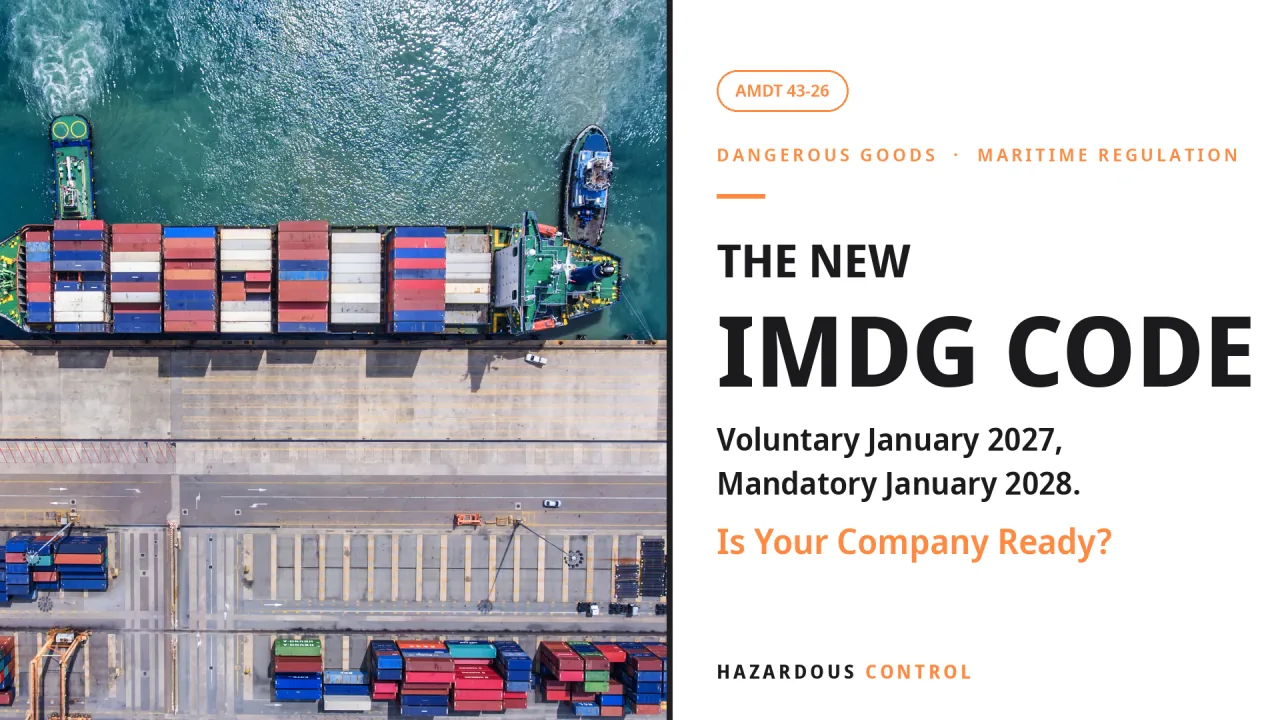
The New IMDG Code: Voluntary January 2027, Mandatory January 2028. Is Your Company Ready?
It is late September 2026. A forwarder books an electric SUV in a container for a January 2027 sailing. The booking clerk pulls up UN3556, vehicle lithium-ion battery powered, from the IMDG Code list that became mandatory this January. The carrier replies asking about the new vehicle safety assessment and whether the box will be placarded. The clerk has never heard of either requirement. Which rules apply to that sailing, and is the team working from the current book?
Every preventable shipping error turns into a financial loss: storage charges accumulate, rebooking adds costs, and missed sailings put customer contracts at risk.
What was published
The book in question is the IMDG Code 2026 edition incorporating Amendment 43-26, published by the IMO in September 2026 and adopted at the Maritime Safety Committee’s 111th session in May 2026. Like every IMDG amendment, it comes with two dates: voluntary application from 1 January 2027, mandatory entry into force on 1 January 2028. The sixteen months between publication and obligation are the industry’s preparation window. The question is what companies do with them.
What changes
The amendment continues the regulatory response to the electrification of cargo. Amendment 42-24, mandatory since 1 January 2026, had already retired the old catch-all UN 3171 for battery-powered vehicles and replaced it with chemistry specific entries: UN3556 for lithium-ion, UN3557 for lithium metal and UN3558 for sodium-ion battery powered vehicles. Amendment 43-26 tightens the regime around those entries. It introduces a new Special Provision 980 establishing a vehicle safety assessment, revises Special Provisions 961 and 962 with clearer and stricter criteria for the transport of vehicles including electric vehicles, adds new UN entries for lithium and sodium-ion battery systems, updates segregation distances for radioactive cargo, and carries consequential amendments into the EmS Guide.
The practical direction is unmistakable: the physical condition of the vehicle and the fire protection of the ship’s vehicle spaces now sit at the center of the decision. Under the 42-24 framework, the SP 961 exemption for ro-ro transport already required stowage in spaces meeting SOLAS Chapter II-2 regulation 20, with no leakage or damage to the traction battery system, and it never applied to containerized transport, where SP 962 requires a full dangerous goods declaration. Amendment 43-26 builds on that logic with an explicit safety assessment requirement. The operational consequence is that “exempt” is no longer a box to tick on a form; it is a judgment about the vehicle in front of you and the ship it will sail on.
What ready looks like
So what does ready look like? Three things, none of them exotic. First, systems current: booking and documentation platforms updated with the new entries and special provision references before the first 2027 sailing, not during the last quarter of 2027. Second, carrier coordination at booking stage: confirming how each operator applies the vehicle provisions, including container placarding, before the cargo reaches the terminal. Third, people current: operations and documentation staff trained on the difference between the 42-24 vehicle regime they learned this year and the 43-26 regime they will work under next.
Not ready looks familiar, because the industry has rehearsed it with every amendment cycle. A team works from the previous edition into late 2027, a carrier rejects a vehicle booking or demands placarding and a safety assessment nobody prepared, and the container sits at the terminal while the sailing leaves. The costs are the ordinary ones: storage, rebooking, a missed connection, a customer explaining to their customer why the cars are late. Multiplied across a year of vehicle shipments, the voluntary year that was meant for preparation becomes the year of paying for its absence.
Two clarifications
Two clarifications are worth making, because confusion here is expensive. Amendment 43-26 does not change the Special Provision 188 picture for small lithium batteries: compliant packages remain exempt from dangerous goods provisions, and the World Shipping Council’s container-threshold proposal runs on a separate track, with the Editorial and Technical Group expected to take it up in spring 2027 toward a possible Amendment 44-28. Do not mix the two debates. And voluntary application is not a preview for enthusiasts; it is the mechanism by which administrations and companies align before the mandatory date. A company that updates its procedures in March 2027 is compliant and calm. A company that starts in November 2027 is neither.
Readiness, in the end, is a checklist, not a feeling. The regulation is published, the dates are fixed, and the changes are specific enough to act on today. The companies that will sail smoothly into 1 January 2028 are the ones treating the next fifteen months as working time.
Lack of knowledge does not relieve you of responsibility.
Training
If your team ships vehicles or battery systems by sea, function-specific IMDG training helps turn regulatory requirements into practical checks before booking: hazardouscontrol.com.
Sources
- International Maritime Organization (IMO) — IMDG Code, 2026 edition
- Britannia P&I — Amendment 42-24 summary
- World Shipping Council — SP 188 battery cargo safety gap
By Natalia Pérez, Hazardous Control Inc., Miami. Also published on LinkedIn.