October 9, 2026
Lithium batteries just got banned from the trash. Warehouses should pay attention.
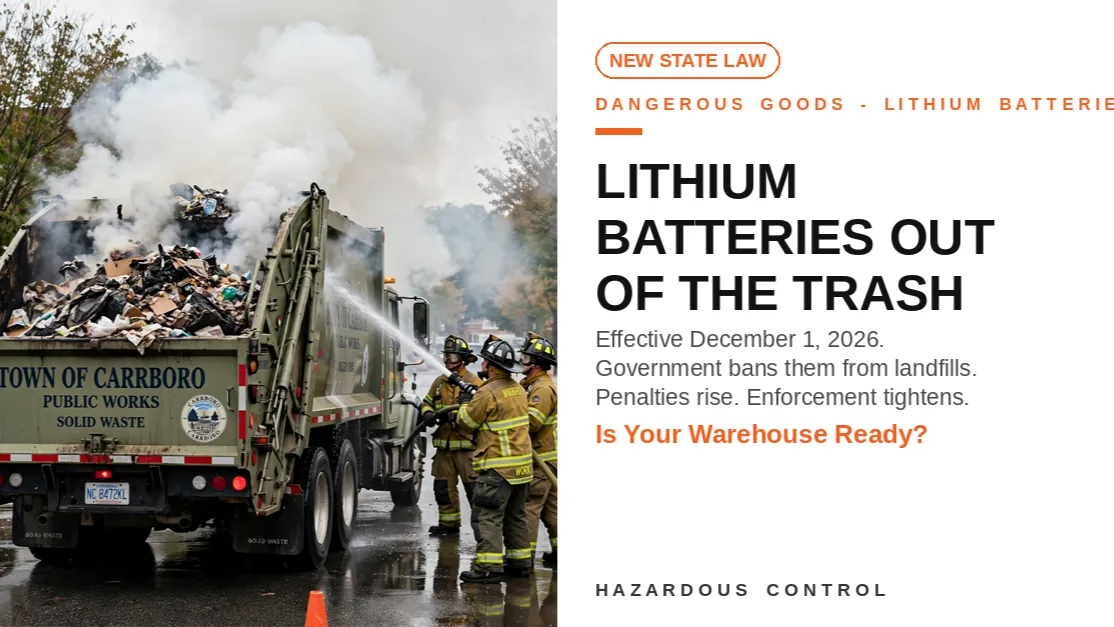
Starting December 1, 2026, North Carolina law (G.S. 130A-309.10) prohibits lithium-ion batteries from going to landfills or incinerators. The state did not ban them because of paperwork. It banned them because discarded batteries kept setting garbage trucks on fire, including one in Carrboro this past September.
The state guidance is simple: protect the terminals, keep batteries in non-conductive containers, and take them to designated drop-off points. No curbside recycling bin, no trash.
Here is what changes for companies. Any business accumulating returned, swollen, or damaged batteries is now managing a regulated waste stream, whether it calls itself a recycler or not. A damaged lithium battery is not universal waste. Under EPA guidance it moves as hazardous waste, with a manifest, to a permitted facility, and the people who pack it, mark it, and sign for it need documented hazmat training under 49 CFR 172.704.
Most warehouses I visit still run this on improvisation: a corner bin, no quarantine criteria, no trained owner of the process. That is exactly the gap this law is aimed at, and North Carolina will not be the last state to close it. The direction is consistent everywhere: penalties for getting battery disposal wrong keep rising, and enforcement keeps getting stricter.
At Hazardous Control we are launching specialized training on the handling and disposal of degraded lithium batteries, built on 49 CFR 173.185(f) and the EPA rules that apply in Florida. If your team touches battery returns, this is the year to get the process in writing.
Natalia Pérez
International Hazardous Materials Transportation Instructor and Specialist
Hazardous Control Inc.
By Natalia Pérez, Hazardous Control Inc., Miami. Also published on LinkedIn.